
Hello community,
I can hardly believe that summer has arrived already.
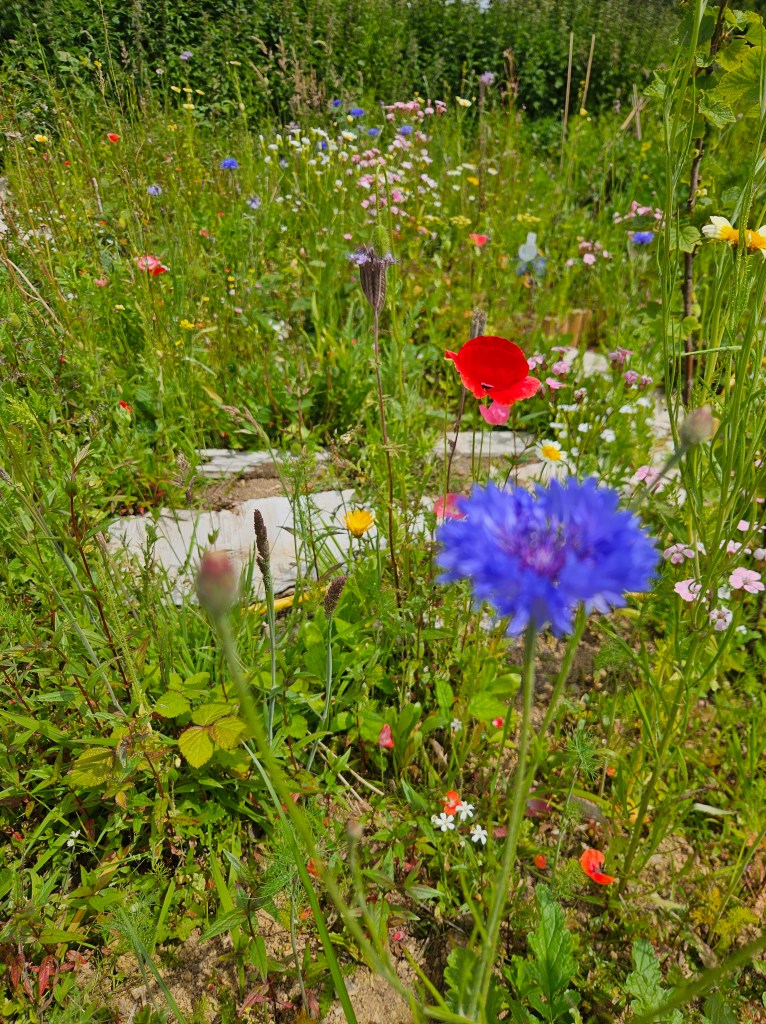
This year, my family made a very exciting commitment to a more off-grid, nature-connected way of life. Nothing has brought me more joy than wandering into the garden to pick fresh lettuces and broad beans, or watching newly planted wildflowers burst into colour. There is something deeply grounding about being so closely connected to the rhythms of the natural world.
I hope this summer is bringing you as much joy as it is bringing me, even on the days when the sun decides not to make an appearance.
As we move further into the summer months, I am also very glad to be winding down and taking some time away from work. I cherish this season as an opportunity to rest, recharge, and return feeling nourished and refreshed. I hope that you, too, have some nourishing time planned over the summer. Please do take some well-deserved rest. You deserve it.
And while I may be slowing down a little, our community certainly isn’t. This month we’re exploring creative evaluation, sharing practical tools and ways to spice up our evaluation, and celebrating a community that is now approaching 300 members strong.
I am also very excited to be giving you, my lovely community, a sneak preview of my latest project (read below to find out more)
So, put the kettle on, grab a pen and paper, and settle in. Whether you’re reading from a sunny garden, a busy office, or somewhere in between, I hope this newsletter offers a moment to pause, reflect, and find inspiration for your evaluation practice.
Happy reading ☕🌱
Tool of the moment
Skills Matrices
A skills matrix is a simple way of exploring how confident people feel about a particular set of skills or knowledge areas.
At the start of an event, programme, or project, participants rate their confidence against a series of statements or skills using a scale (for example, 1 to 4). At the end, they complete the same ratings again, allowing you to see where confidence has shifted over time.
What is it good for?
Skills matrices are particularly useful for identifying changes in self-reported confidence and perceived capability. They can help demonstrate learning, development, and growth across a programme.
To deepen your understanding, consider pairing the ratings with an open-ended question such as:
“What other skills, knowledge, or insights have you developed during this programme?”
This can help uncover unexpected outcomes and learning that may not have been captured in your original skills framework.
Top tip
Skills matrices are wonderfully flexible. They can be used in traditional surveys, online forms, or more interactive formats. For in-person events, try creating four corners of a room representing different confidence levels and invite participants to physically position themselves. Not only does this generate useful data, but it can also spark valuable conversations and reflection.
🫖 Evalua-Tea Community Live 🫖
Come and join us for next Evalua-Tea community live!
Getting creative with your evaluation
Save your seat here: https://us02web.zoom.us/meeting/register/-4bJpJroTMyHOup8tuf_Ug
You voted, and I listened!
The votes are already in for our next theme, and it seems many of us are ready to inject a little more creativity into our evaluation practice!
From jelly baby trees and reflective journals to ping pong balls, visual methods, creative prompts, and everything in between, we’ll be sharing practical ideas, favourite tools, and creative approaches that help people think, reflect, and evaluate differently.
Whether you’re already experimenting with creative methods or simply curious about what’s possible, come along and join the conversation.
What to expect
20 minutes
Welcome, introductions, settling in, and a gentle exploration of the topic.
20 minutes
Small group discussions (yes, breakout rooms are back!).
15 minutes
Sharing insights, reflections, and collective learning.
5 minutes
Key takeaways and closing reflections.
Bring your pen and paper, a warm cup of tea, and an open heart and mind.
Can’t make it?
If you’d love to join the discussion but can’t make the live session, don’t worry. We’ll share key reflections, resources, and highlights in the next newsletter, so keep an eye on your inbox.
Tea of the Month
This month we’re drinking: English Breakfast
Why this tea:
Because I am drinking one right now whilst writing this and it feels like a warm hug! Who doesn’t want a warm hug in tea form?
As you sip, consider:
How might you create more space for reflection, curiosity, creativity in your evaluation work?
Reflective prompt…
Grab yourself a pen and paper and simply write …no overthinking!
As summer unfolds, take a moment to consider the natural rhythms around you.
What in your work, your thinking, or your evaluation practice is currently flourishing? What has needed careful tending to reach this point?
And just as importantly, what might benefit from being left fallow for a while, given space to rest, restore, and gather energy for a future season?
Write for five minutes without editing, noticing what emerges when you allow yourself to reflect on growth, nourishment, and rest as essential parts of the same cycle.
Beyond data Collection: Reciprocity as the heart of ethical evaluation
What does it really mean to evaluate ethically? In our recent Communi-tea Live, we brought together colleagues from public engagement, researcher development and impact roles across higher education to explore this question. Our discussion revealed that ethical evaluation is about much more than consent forms and ethics approval.
It starts with how we show up: being transparent, compassionate and respectful of participants’ time and experiences. A particularly powerful theme was reciprocity. Rather than viewing evaluation as a process of extracting information, we explored how it can become a mutually beneficial experience that creates value for participants as well as evaluators.
We also discussed trust, transparency, sensitive data collection, the role of ethics approval, and whether the sector needs stronger guidance and infrastructure to support ethical evaluation practice. Ultimately, we came back to one simple question: “Are we doing right by the people involved?” Read the full blog to explore the key insights and practical reflections from the conversation.
What consistently helps is starting earlier than feels necessary. Making plans for evaluation at the outset, and then embedding it wherever possible throughout the project cycle. That might mean building reflection moments into activities, collecting lighter-touch data along the way, or aligning evaluation questions with decisions you already need to make. When evaluation is part of the rhythm of a project, it becomes more manageable and more useful.
One other thing we keep coming back to is this: there is no failing at evaluation. There is no perfect design, no flawless dataset, no gold-standard approach that fits every context. Putting a plan in place, doing the best you can with the time and resources available, and using evaluation as a tool to learn and reflect is enough. Evaluation is not about proving perfection. It’s about understanding what happened, what shifted, and what you might do differently next time.
In short, earlier planning and a little self-compassion go a long way.
An Update on our growing community
As we approach our third Community Live and celebrate five months of this community being in action, I’m finding myself reflecting on just how far we’ve come. We are now nearly 300 members strong!
That’s almost 300 people who have said “yes” to investing in their evaluation knowledge, skills, and practice. Among us are public engagement professionals, impact officers, researcher developers, REF teams, outreach practitioners, STEM programme leads, research culture specialists, and many more besides.
While our roles, organisations, and contexts may differ, what continues to strike me is how much we have in common. We share the same questions, wrestle with similar challenges, navigate familiar constraints, and often draw from the same tools and techniques. We all experience those moments when evaluation feels inspiring and insightful, and those moments when it feels messy, complicated, or difficult to prioritise.
That’s why this community matters. It creates a space where we can come together, learn from one another, share our experiences openly, and continue growing our evaluation practice collectively. Thank you for being part of it.
A Little Bit of Exciting News… ☕
I’ve been quietly brewing a few things behind the scenes over the last few months (tea has definitely been involved!).
I’m delighted to share that I’m currently putting the finishing touches to a brand-new brochure, which will be launching very soon. Exciting? Absolutely. Slightly nerve-wracking? Also yes!
As part of the launch, I’m even having a professional photoshoot, which feels both exciting and a little surreal.
But that’s not all.
I’ve also been creating something that I think many of you will find useful: a deck of Evaluation and Impact Reflection Prompt Cards. Designed to spark thinking, encourage reflection, and support meaningful conversations, these prompts can be used individually, with teams, or as part of workshops and evaluation activities.
And because you’re part of this wonderful community, I’d love for you to be among the first people to see them.
The first 100 people to sign up will receive a FREE digital copy of the prompt card deck.
Why? Because you’ve been part of this journey, and because I’m passionate about supporting you to grow your confidence, impact, and evaluation practice.
Sign up here to claim your free copy and be among the first to explore the cards.
Thank you…
Thank you for being here at the very beginning. If anything in this issue stirred a thought or a question, you’re welcome to reply. We read every response.
We hope to see you at the next community live- in the meantime go forth and brew boldly!

 Engagement with Impact